In the Age of AI, the Best Classroom Tool Might Be a Deck of Cards
Why screen-free, hands-on play is exactly what students need right now — from someone who works with AI-era students every day.
I work at a university, so I get a close-up view of how fast AI is changing things for students. Essays in seconds. Code on request. Summaries, slides, study notes, whatever you need.
Most teachers I talk to are asking some version of the same question. If the answer machine is in everyone's pocket, what are we actually supposed to teach?
I don't have a complete answer. But I keep coming back to the same idea: teach the stuff AI can't do for you.
What AI can't do
AI can write a business plan. Fine. It can't notice that the seniors in your neighbourhood have no good way to get groceries. Somebody has to actually look around for that.
It can write a pitch. It can't stand up in front of a room and give one, with your voice shaking a bit and your team watching you.
It can list a hundred ideas in ten seconds. It can't sit in a group of four people who disagree and get them to one idea everybody actually wants to build.
Noticing problems. Working with people. Changing your plan when it falls apart. Saying your idea out loud. That's most of what entrepreneurship actually is, and none of it happens on a screen.
Why cards
Here's the part that sounds backwards. I think one of the better ways to get students ready for a high-tech future is a table with no tech on it.
Card games never needed an update. Nothing to log into, nothing to charge, no accounts, no "sorry, the site is down today." And there's no gap between the kid with the new phone and the kid without one. Everybody gets the same cards.
The other thing is constraints. Open a chat window and you get an infinite blank page, and blank pages are hard. A card is small and specific. A town where it's illegal to drop anything off a cliff. A place that bans all advertising. Give a student a weird limit instead of nothing and the ideas come faster. I can't fully explain why that works, but I've watched it work every time.
I'm not anti-AI
I want to be clear about that, because "put down the screens" arguments usually end up somewhere I don't want to go.
I use AI. My students use AI. They should.
But the order matters. Learn to think first, then learn to hand some of the thinking off. A student who has practiced finding a problem, arguing for a solution, and rebuilding a plan after it breaks can use AI like a tool. A student who hasn't just takes whatever it gives them, and has no way of knowing if it's any good.
What it actually looks like
Forty-five minutes and a table of teenagers. They draw a town, say a floating village where everything moves with the tide. They pick a problem, sketch out a business, and then a wildcard lands and wrecks the plan, and they fix it, usually while giving each other a hard time about it. Then they stand up and pitch.
No logins. No screens. A lot of noise.
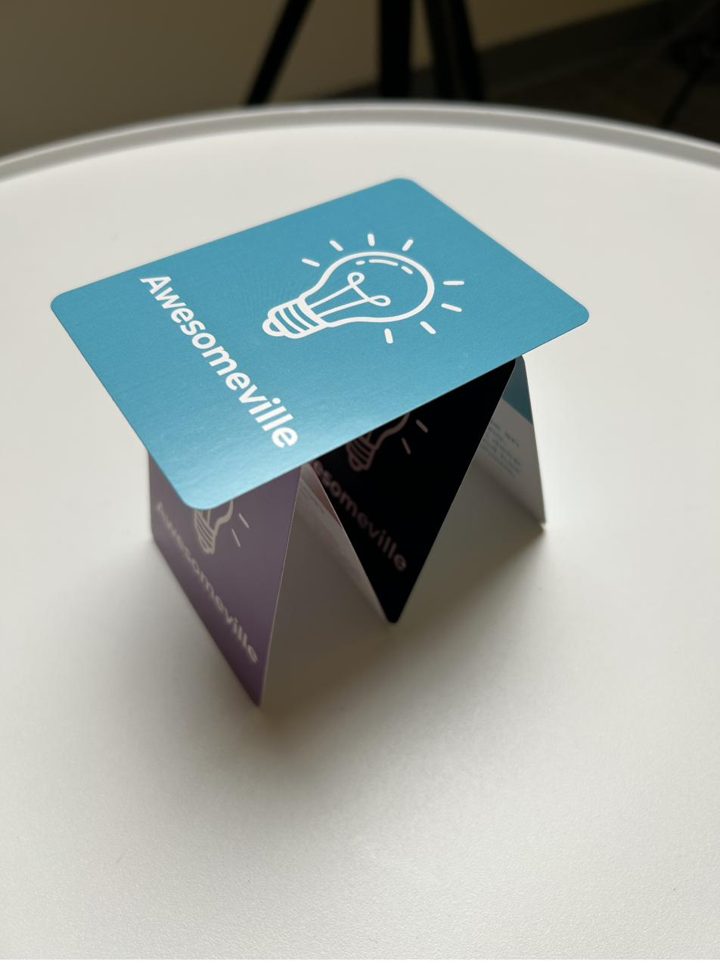
That's what I built Awesomeville for. It fits in a backpack, it doesn't need wifi, and it teaches the parts that make everything else useful, AI included.
Bring this kind of learning to your classroom
Awesomeville is a screen-free entrepreneurship card game for classrooms, workshops, and youth programs.